How Much Does It Cost to Set Up a GCC in India?
A Complete Cost and ROI Guide
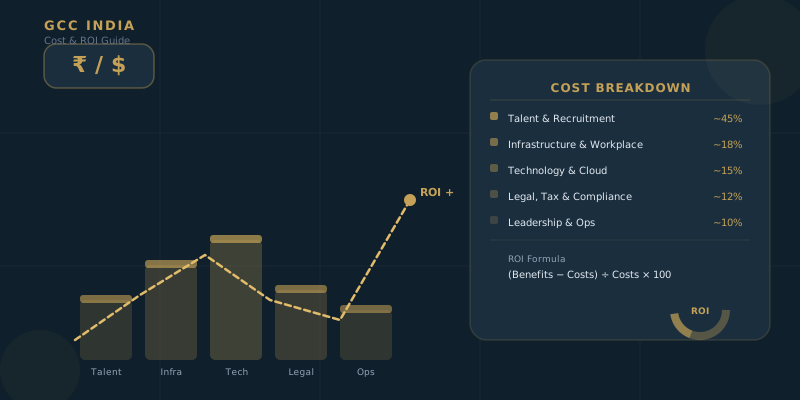
India has become a strategic destination for companies looking to expand their engineering capabilities, strengthen technology operations and build long-term global teams. Global Capability Centres offer an opportunity to access skilled talent, improve operational efficiency and develop capabilities that support global growth.
However, one of the first questions business leaders ask is straightforward: How much does it actually cost to establish and operate a GCC in India?
The answer depends on several factors, including team size, location, hiring requirements, infrastructure, operating model and long-term business objectives. Understanding these costs before making an investment can help companies choose the right setup strategy, establish realistic budgets and avoid expenses that may otherwise emerge during expansion.
In this guide, we explore the major cost components of setting up a GCC in India, the factors that influence total investment and how businesses can evaluate the potential return on investment.
1. Understanding the Cost Structure of a GCC
Establishing a GCC involves more than hiring employees. Businesses must account for the infrastructure, operational processes and management capabilities required to run a reliable delivery organisation. The major cost components generally fall into five categories.
Talent and Recruitment
For most technology-focused GCCs, employee compensation is one of the largest recurring expenses. Costs vary depending on the roles being hired, experience levels, technical specialisations and location. Additional expenses include recruitment and hiring fees, onboarding and training, employee benefits and insurance, retention initiatives and performance incentives, and replacement hiring and knowledge transfer.
Infrastructure and Workplace
Traditional GCCs may require office space, equipment, connectivity, security systems and other workplace facilities. However, the investment depends on the chosen operating model. Companies adopting hybrid or remote-first approaches may reduce their physical infrastructure requirements while investing more in collaboration tools, endpoint security and cloud-based systems. Before committing to a long-term office lease, businesses should evaluate whether their actual operating requirements justify the investment.
Technology and Cloud Infrastructure
Technology costs can include cloud hosting, development environments, software licences, cybersecurity tools, monitoring systems and collaboration platforms. For engineering-focused GCCs, these expenses may fluctuate as workloads grow and new products or services are introduced. A well-designed technology environment helps teams operate securely and efficiently without introducing unnecessary infrastructure expenses.
Legal, Compliance and Administration
Depending on the structure of the Indian operation, companies may need to account for incorporation, legal advice, taxation, employment compliance, accounting, payroll and other administrative requirements. The scope and cost of these activities depend on the company's legal structure, industry and operating arrangements. These requirements should be assessed with qualified local legal, tax and compliance professionals before the GCC is launched.
Leadership and Operational Management
A GCC requires clear ownership of delivery, engineering standards, performance management and communication with global stakeholders. These responsibilities may involve local leadership, project management, engineering management, HR and finance support. These expenses are sometimes underestimated because companies focus primarily on salaries for individual contributors rather than the complete operating structure required to support them.
2. What Factors Influence the Total Cost?
There is no single cost that applies to every GCC. Two companies establishing centres in the same city may have significantly different investment requirements. The most important factors include:
- Team size and composition: A small engineering team has different leadership, infrastructure and recruitment requirements from a large multi-functional centre.
- Location: Salaries, office rentals and local talent availability vary between cities and specialised technology markets.
- Hiring complexity: Roles requiring niche expertise or extensive experience can take longer to fill and may involve higher recruitment costs.
- Operating model: A company establishing its own entity will have different responsibilities and expenses from one working through a managed operating arrangement or another suitable partner model.
- Growth expectations: Businesses expecting rapid expansion need to consider future hiring, management capacity and infrastructure requirements.
- Business maturity: A company with established engineering standards and documented processes may require less initial operational development than one building these capabilities from scratch.
The most effective budgeting approach is to model the complete operating environment rather than evaluating individual salary costs in isolation.
3. Traditional GCC vs Micro-GCC: Understanding the Investment Difference
Not every organisation needs a large capability centre from the beginning. A traditional GCC may be appropriate for companies planning substantial operations, multiple business functions and long-term local leadership structures.
A Micro-GCC offers an alternative for businesses that want to establish a smaller, focused team aligned with specific business objectives. For example, a company might begin with a dedicated engineering team supporting product development, cloud infrastructure or data engineering. The operating model can then evolve as the business demonstrates demand and develops a clearer understanding of its long-term requirements.
"A Micro-GCC should not simply be viewed as a smaller version of a traditional GCC. Its value comes from designing the operating model around the company's immediate needs while preserving a clear path for future growth."
4. How to Calculate the ROI of a GCC
The financial value of a GCC should be evaluated against its complete operating costs and the benefits it creates. A basic return-on-investment calculation is:
ROI Formula
ROI = (Total Benefits − Total Costs) ÷ Total Costs × 100
For example, consider a hypothetical business that invests ₹1 crore in establishing and operating a GCC over a defined evaluation period. If the business identifies ₹1.3 crore in measurable financial benefits over that same period:
These figures are illustrative only. They are not a forecast of the return a company should expect from a GCC. The evaluation period and definition of benefits must always be consistent.
Benefits may include reduced external delivery costs, lower recruitment or replacement expenses over time, improved engineering productivity, faster product development and release cycles, greater control over technical knowledge and intellectual property, and improved continuity across critical business functions.
5. The Hidden Costs Companies Should Not Ignore
A realistic business case includes costs that are easy to overlook during initial planning.
Employee Attrition
When experienced employees leave, companies may incur replacement hiring expenses, onboarding costs and temporary productivity losses. Retention planning and a strong engineering culture can help reduce these risks.
Knowledge Transfer
Teams need sufficient documentation, architectural context and domain knowledge to operate independently. If these foundations are missing, businesses may spend considerable time and cost transferring knowledge.
Management Overhead
A GCC requires effective communication between local teams and global stakeholders. Unclear ownership, excessive meetings and duplicated responsibilities can reduce productivity and add invisible cost.
Underutilised Capacity
Hiring too quickly can leave teams without sufficient work. Hiring too slowly can delay product development. Workforce planning must be aligned with a realistic delivery roadmap.
Security and Compliance
Businesses operating across jurisdictions may face additional requirements involving data protection, access management, regulatory obligations and internal controls. These costs should be assessed according to the company's industry and the nature of its operations.
6. Building a Practical GCC Business Case
Before establishing a GCC, decision-makers should develop a structured business case that connects investment decisions to measurable business objectives. A useful business case should answer five questions.
What business problem are we solving?
Identify whether the objective is to increase engineering capacity, improve product ownership, reduce delivery constraints, build specialised expertise or establish a long-term technology presence.
What operating model fits our needs?
Compare a traditional GCC, Micro-GCC, managed team or other suitable arrangement based on control, cost, governance and growth requirements.
What investment is required?
Estimate setup expenses, recurring operating costs, recruitment requirements, technology expenditure and management overhead.
How will success be measured?
Define metrics such as total cost of delivery, time to hire, employee retention, deployment frequency, delivery predictability and business outcomes.
What happens if the business needs to scale or change direction?
Consider how the operating model accommodates future hiring, changing workloads and evolving business priorities.
7. A Smarter Approach to GCC Investment
The most cost-effective GCC is not necessarily the one with the lowest initial investment.
An operating model that appears inexpensive at launch may become costly if it lacks technical ownership, leadership, documentation or the ability to retain experienced employees. Likewise, establishing a large centre before the business has sufficient demand can create unnecessary financial commitments.
A more sustainable approach is to align the initial investment with actual business priorities, establish clear accountability and expand when the operating model demonstrates value.
For some organisations, that means establishing a full GCC with dedicated infrastructure and leadership. For others, it means starting with a focused Micro-GCC and expanding as their engineering requirements grow. The right decision depends on the company's strategic objectives, financial position and long-term plans.
Conclusion
Setting up a GCC in India can be a strategic investment in talent, engineering capability and long-term business growth. However, its financial success depends on more than salary comparisons or headline cost savings.
Companies need to understand the complete cost structure, select an appropriate operating model, account for hidden expenses and establish a realistic framework for measuring ROI.
By evaluating these factors before making a commitment, business leaders can make better-informed decisions about how to build and scale their operations in India.
At Humalligence, we believe that building engineering capability should begin with a clear understanding of business goals, operational requirements and the value the team is expected to create.
Related Insights
The GCC Gap: Why Mid-Market Technology Companies Can No Longer Afford to Wait
Enterprise companies have GCCs. Mid-market companies haven't had a viable alternative until now.
How GCCs Changed Hiring Culture in India
GCCs didn't just bring jobs to India they rewired how Indian professionals think about careers, ownership, and ambition.
Planning to Build or Expand Your Engineering Capability in India?
Connect with Humalligence to explore an operating model aligned with your business objectives, team requirements and long-term growth plans. No proposals, no scope documents but just a direct conversation.
[email protected]No proposals. No scope documents. Just a direct conversation.