The GCC Gap: Why Mid-Market Technology Companies Can No Longer Afford to Wait
There is a quiet competitive advantage that large technology companies have held for the better part of two decades. One that rarely gets discussed alongside product strategy, market positioning, or brand differentiation.
They built Global Capability Centres in India.
Not outsourcing relationships. Not vendor contracts. Dedicated engineering units with their own management, their own culture, their own accountability to the product roadmap. Engineering teams that operate like an extension of headquarters, because in every practical sense, they are.
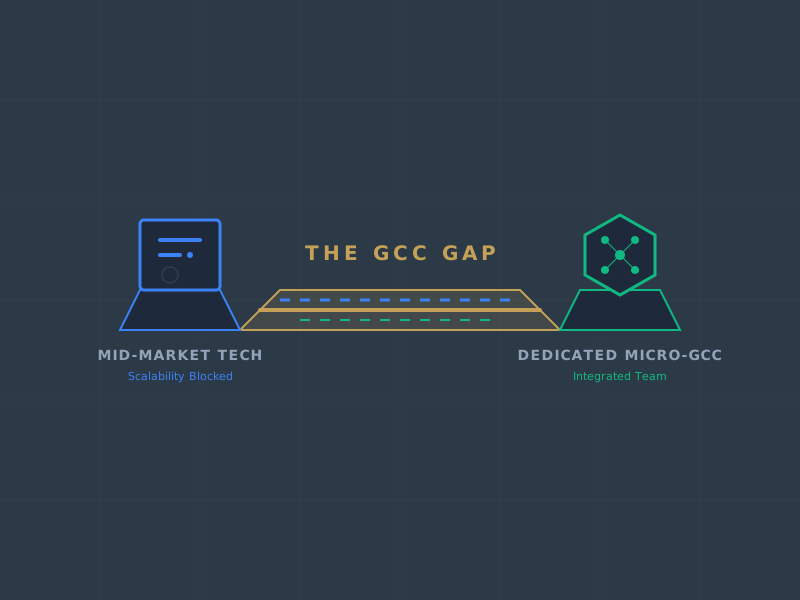
For enterprise companies, the GCC model is settled infrastructure. For the mid-market the 80-person SaaS company, the 350-person regulated technology firm, it has remained out of reach. Entity setup alone can run to six figures before a single engineer is hired. Add 12 to 18 months of ramp-up, local HR and legal complexity and the management overhead of running a multi-geography operation and the economics simply do not work at smaller scale.
So most mid-market companies have watched from the sidelines. That is starting to change. And the organisations that recognise it early will have a structural advantage that is genuinely difficult to replicate quickly.
"Companies that build engineering capability in India over the next 24 months will have teams that are integrated, productive and culturally calibrated by the time their competitors are still negotiating vendor contracts."
Why the GCC Model Is No Longer Exclusive to the Enterprise
Two things are shifting to make the dedicated offshore capability model accessible to mid-market technology companies for the first time.
The first is structural. India's engineering talent pool is deep, experienced and substantially more sophisticated than the cost-arbitrage narrative of the early 2000s would suggest. Senior engineers with 10-plus years of experience in specialised domains regulated software, cloud infrastructure, laboratory informatics, compliance-driven development are available outside the tier-one cities that have historically attracted enterprise GCCs. The talent is there. The question has always been how to access it without building an entity to do so.
The second is operational. The Micro-GCC model is a principal-led, dedicated capability pod that functions as a client's offshore engineering team without entity setup or infrastructure overhead, It closes this gap directly. It is not a smaller version of an outsourcing contract. It is a different operating model altogether.
What the Next Five Years Look Like
The conversation in technology leadership circles is moving. The question is no longer whether to have an engineering presence in India. For companies at a certain scale, the question is becoming when and how. Several trends are driving this shift.
AI is changing the nature of engineering demand, not reducing it
As AI tools compress certain categories of development work, the premium shifts toward domain expertise, systems thinking and governance capability. These are not attributes you acquire at short notice. They are built over time, inside teams with continuity and institutional memory. A company that has a stable, domain-deep engineering pod operating in this environment is better positioned than one that tries to assemble capability at the moment demand arrives.
Regulated industries are adding technical complexity faster than headcount
The lab of 2030 is a software-defined environment. Regulated industry tools, AI-assisted data capture, instrument integration and validated cloud infrastructure are becoming table stakes. The companies building that infrastructure need engineering depth, not just engineering volume. Domain expertise in GxP environments, computer system validation and data integrity is in short supply globally. Building a dedicated team around that expertise and retaining it, is increasingly a strategic decision.
The Build-Operate-Transfer pathway is normalising
Companies that are not ready to own a GCC independently today are structuring their offshore engagements to make that transition easier in the future. A BOT arrangement where a provider builds and operates the team then transfers ownership at a defined maturity milestone is a sensible on-ramp for organisations that know where they want to end up but are not yet in a position to get there directly.
The Cost of Waiting
There is a cost to inaction that does not appear on a balance sheet until it does.
Companies that build engineering capability in India over the next 24 to 36 months will have teams that are integrated, productive and culturally calibrated by the time their competitors are still negotiating vendor contracts. Institutional knowledge compounds. Team continuity compounds. Domain expertise, built over a sustained period inside a stable team, compounds.
The organisations that wait and continue to manage the trade-offs of traditional outsourcing in the hope that a better option will emerge more conveniently later are not standing still. They are falling behind relative to the ones that are building now.
The Micro-GCC is not the future of offshore engineering. It is the option that most mid-market companies have not yet examined seriously and it is available today.
Related Insights
In the Age of AI, Human Accountability Is the Competitive Advantage
In regulated industries, AI accelerates delivery but cannot replace human accountability. Learn why operator-led engineering teams remain the critical differentiator.
The Hidden Cost of Outsourcing Your Business in India
Outsourcing can either accelerate your business or quietly weaken its foundation. Discover why small early decisions matter.
Start the Conversation
If you are a technology or engineering leader wondering when the right time is, what the right structure looks like, or whether the economics work at your scale, those questions are answerable. Not in a whitepaper, but in a direct conversation with engineers who don't just advise on capability centres, but actively build and operate them.
[email protected]No proposals. No scope documents. Just a direct conversation.