In the Age of AI, Human Accountability Is the Competitive Advantage
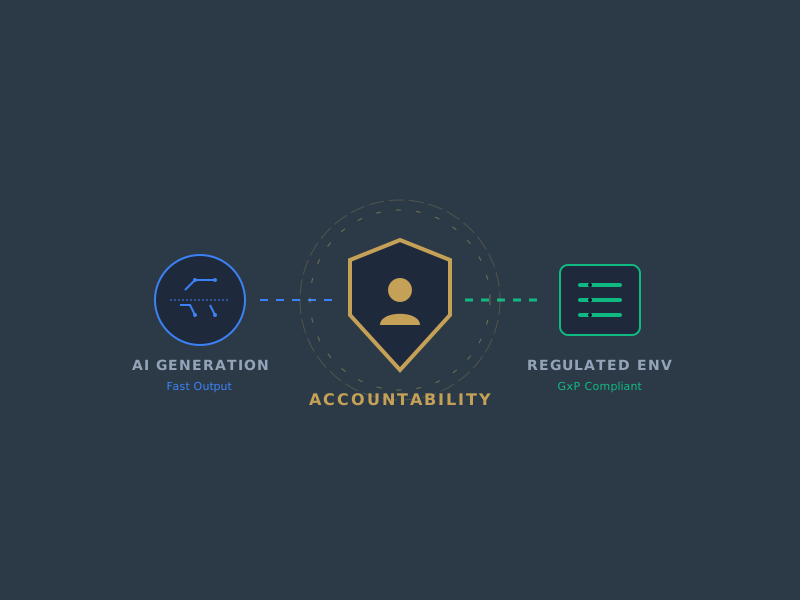
There is a version of the AI future that gets discussed in board meetings and technology conferences. AI accelerates code generation, compresses delivery timelines, automates testing, reduces the need for large engineering teams. The efficiency gains are real. The productivity data is compelling.
But there is a detail this narrative consistently underestimates. It is the detail that matters most to any company operating in a regulated environment.
AI can generate code. It cannot hold regulatory accountability. AI can accelerate validation runs. It cannot sign off on a GxP-compliant system. AI can suggest an architecture. It cannot own the delivery.
In GxP-regulated engineering, the question was never "human or AI." The question has always been: who is accountable? And accountability, by definition, requires a human being.
"The engineering teams that will create the most value in this environment are not the ones moving fastest. They are the ones who understand what they are building well enough to build it correctly the first time."
The Efficiency Trap
Every technology organisation feels the pressure to move faster. AI tools genuinely help with that. GitHub Copilot, automated test generation, LLM-assisted code review - these are real accelerants and any serious engineering team is evaluating or actively using them.
The risk is not in adopting these tools. The risk is in mistaking tool adoption for capability.
A team equipped with AI tools is only as effective as the judgment behind those tools. In regulated software development, where data integrity requirements are not negotiable, where validation documentation is not optional, where a failed audit carries real operational and commercial consequences, raw output speed is the wrong metric entirely.
What regulated technology companies need is not faster code generation. They need engineers who understand why certain architectural decisions create compliance risks. They need delivery leads who know what a 21 CFR Part 11 audit looks like, not because they read about it, but because they have been through one. They need a governance model where accountability is named, visible, and held.
AI does not change that requirement. In many ways, it raises the stakes for getting it right.
What "Human-Led" Actually Means in Practice
There is a version of "human-led" that is essentially marketing language. A vendor telling a client that their people are in the loop. That is not what is being described here.
At Humalligence, human-led means something operationally specific.
It means the delivery lead who sits in your weekly governance call is the same person accountable for what the team ships. It means the team that onboards into your regulated industry environment in month one is the same team that understands your validation approach in month twelve, because there is no rotation, no handoff, no "your account manager has changed" email.
It means that when a compliance question comes up mid-sprint, it is answered by someone with 15 years of domain experience in regulated software environments, not escalated to a senior consultant who will schedule a call for next week.
"This is what distinguishes operator-led delivery from vendor-managed delivery. One is structured around contracts and outputs. The other is structured around ownership and outcomes."
The AI Opportunity in Regulated Engineering
None of this is an argument against AI. It is an argument for context.
In laboratory informatics, AI is creating genuine opportunities: intelligent data capture from instruments, anomaly detection in lab workflows, predictive maintenance, AI-assisted method development. These are not theoretical applications. They are being implemented in regulated environments today.
But implementing AI in a GxP context is not a general software engineering problem. It requires understanding validation frameworks, risk-based approaches to computer system assurance (CSA), and how to demonstrate that an AI-assisted system meets data integrity requirements. That knowledge does not come from a technology background alone. It comes from years of working inside regulated organisations and understanding how regulators think.
The engineering teams that will create the most value in this environment are not the ones moving fastest. They are the ones who understand what they are building well enough to build it correctly the first time and to defend it if they are ever asked to.
What This Means for Technology Leaders
If you are a CTO or VP Engineering at a technology company, you are likely navigating a version of the same question: how do I scale engineering capacity without scaling governance risk?
The default answers have not kept up with the question. Freelancers bring hands but not ownership. Large outsourcing firms bring scale but not accountability. Generic offshore teams bring capacity but not domain knowledge.
The Micro-GCC model is a different answer. A small, principal-led team embedded in your delivery culture, accountable to your governance standards and deep in your domain is not a compromise between scale and quality. It is the option that mid-market technology companies have been missing.
As AI makes speed more accessible, the lasting differentiator will be judgment. The organisations that build engineering capacity around domain expertise, named accountability and governance that holds will outperform those that optimise for output volume alone.
Related Insights
FastAPI vs Django for Real-World SaaS
Startups don't fail because they picked the "slower" framework. They fail because they picked the wrong foundation for how their system evolves.
Why 90% of Backend APIs Are Over-Engineered
Most backend APIs today are far more complicated than they need to be. Not because the problem is complex but because the solution is.
Start a Real Conversation
If you are building engineering capability for a regulated environment and want a conversation grounded in operational experience rather than vendor positioning, we are ready to talk.
[email protected]No proposals. No scope documents. Just a direct conversation.