Why 90% of Backend APIs Are Over-Engineered (And How to Keep It Simple)
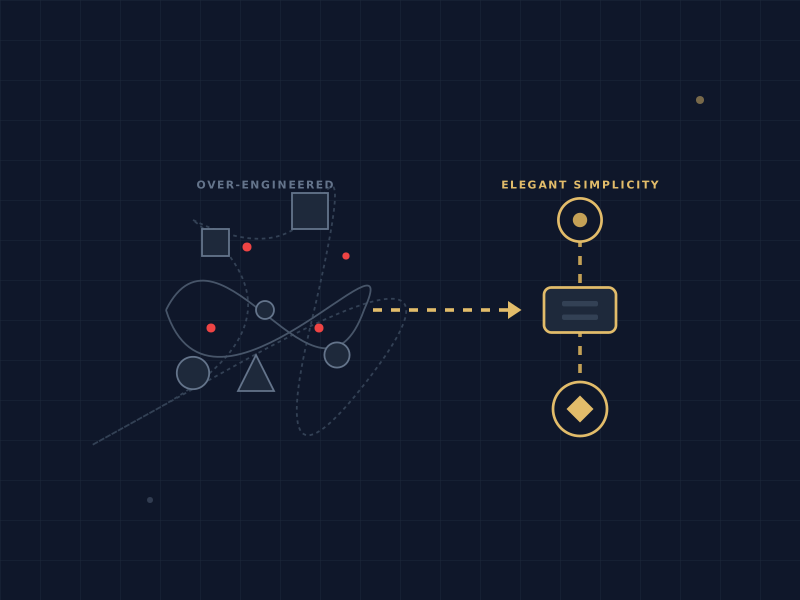
Most backend APIs today are far more complicated than they need to be.
Not because the problem is complex but because the solution is.
You’ll often see:
- Microservices for a product with 3 endpoints
- Event-driven architecture before product-market fit
- Layers of abstraction no one fully understands
And the result?
Slower development, harder debugging and systems that are fragile despite all the “best practices.”
The irony is simple:
The more people try to build scalable systems early, the more they slow themselves down.
This blog is about why over-engineering happens and how to avoid it.
What Over-Engineering Actually Means
Over-engineering is not about writing “too much code.” It’s about introducing:
- Complexity without necessity
- Abstractions without clarity
- Architecture without real scale
A simple API should be easy to:
- Understand
- Modify
- Debug
Why Most Backend APIs Become Over-Engineered
1. Building for Scale That Doesn’t Exist Yet
One of the most common mistakes: Designing for millions of users when you have zero.
Developers often introduce:
- Microservices
- Message queues
- Distributed systems
Before they even validate the product.
The problem is:
- You add operational overhead
- You increase failure points
- You slow down iteration
All for a scale you may never reach.
2. Copy-Pasting Big Tech Architecture
A lot of systems are inspired by Netflix, Uber, or large-scale engineering blogs. But what people forget is:
- These companies solve problems at massive scale
- Their architecture evolved over years
When startups copy this too early, they inherit complexity without context and patterns without necessity.
3. Fear of Refactoring
Many developers over-engineer because they want to “get it right the first time.”
So they:
- Add layers for future flexibility
- Abstract everything
- Generalize too early
But in reality, requirements will change anyway. You end up solving problems that never arrive.
4. Misunderstanding “Clean Architecture”
Clean architecture is often misapplied. Instead of clarity, it becomes:
- Too many layers
- Indirection everywhere
- Hard-to-follow flow
A simple request-response flow becomes:
Controller → Service → Manager → Adapter → Handler → Executor
At that point, debugging is a nightmare.
5. Overuse of Tools and Frameworks
Modern ecosystems provide background workers, queues, orchestration tools and multiple frameworks.
Using them is easy. Knowing when not to use them is hard.
What Simple Systems Actually Look Like
A well-designed API is not minimal, it’s intentional. It:
- Solves current problems clearly
- Leaves room for change
- Avoids unnecessary abstraction
Simple systems feel predictable, understandable and fast to modify.
The Balance: Simple vs Scalable
There’s a misconception that simple systems don’t scale. That’s not true.
Simple systems scale better initially because:
- They’re easier to change
- They’re easier to debug
- They evolve naturally
The key is: Start simple, but don’t be careless.
How to Keep Your Backend APIs Simple
1. Start with a Monolith (and Don’t Be Ashamed of It)
For most startups, a well-structured monolith is the best choice.
It gives you faster development, easier debugging and less operational complexity. You can always split later.
2. Design Around Use Cases, Not Abstractions
Instead of creating generic services, focus on real workflows and actual user actions.
Build for what exists. Not what might exist.
3. Delay Decisions That Don’t Matter Yet
You don’t need to decide the final architecture or perfect scaling strategy on day one. Good systems evolve.
4. Keep Data Flow Clear
If you cannot explain where data comes from, how it transforms and where it goes, your system is too complex.
Clarity in data flow is more important than architecture patterns.
5. Introduce Complexity Only When It Hurts
Don’t add:
- Queues → until synchronous processing becomes a bottleneck
- Microservices → until teams or scaling demand it
- Caching → until performance proves it’s needed
Let real problems justify complexity.
6. Optimize for Debugging, Not Just Design
Ask: "Can I trace a request easily? Can I identify failures quickly?"
A simple system is one you can fix at 2 AM without confusion.
When You Should Add Complexity
Complexity is not bad, it’s just expensive. Add it when:
- Performance becomes a real bottleneck
- Teams need independent services
- System boundaries become clear
At that point, complexity becomes a solution, not a guess.
The Real Insight
Over-engineering is not a technical problem. It’s a mindset problem:
- Wanting to future-proof everything
- Trying to impress with architecture
- Avoiding refactoring
But great systems are not built by predicting the future. They’re built by adapting to it.
Final Thought
Your API doesn’t need to be perfect. It needs to be clear, flexible and easy to evolve.
Because in the end: The best architecture is not the most advanced one. It’s the one your team can understand and improve every day.
Simplicity is not a lack of skill. It’s a sign of deep understanding.
Related Insights
In the Age of AI, Human Accountability Is the Competitive Advantage
In regulated industries, AI accelerates delivery but cannot replace human accountability. Learn why operator-led engineering teams remain the critical differentiator.
The Hidden Cost of Outsourcing Your Business in India
Outsourcing can either accelerate your business or quietly weaken its foundation. Discover why small early decisions matter.
Start the Conversation
If you are a technology or engineering leader wondering when the right time is, what the right structure looks like, or whether the economics work at your scale, those questions are answerable. Not in a whitepaper, but in a direct conversation with engineers who don't just advise on capability centres, but actively build and operate them.
[email protected]No proposals. No scope documents. Just a direct conversation.