Build vs Buy vs Partner: When Does a Dedicated Engineering Pod Make More Sense Than Hiring?
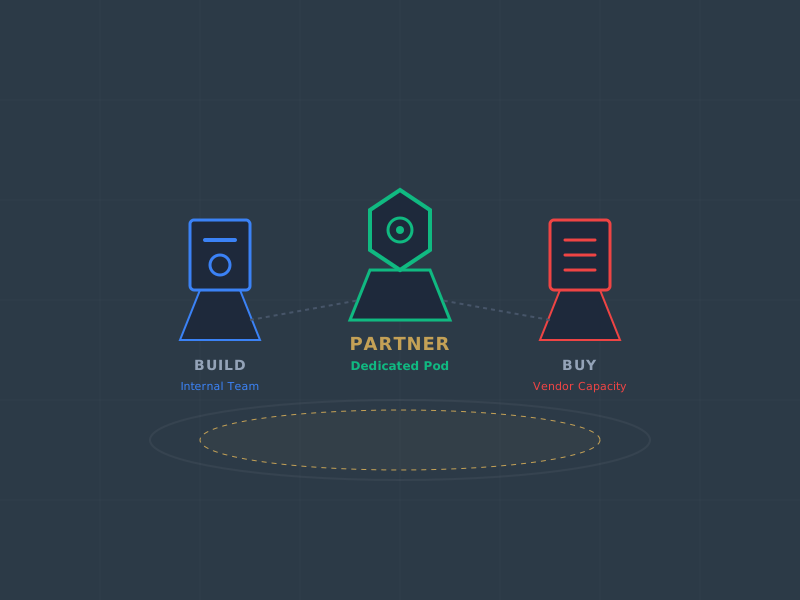
Every engineering leader eventually faces this decision: do I build the team internally, buy the capacity from a vendor, or find a model that sits somewhere in between?
The answer depends on your constraints and most frameworks for making this decision oversimplify it by focusing exclusively on cost. Here is a more practical way to think about it.
Build: hire your own team
Building an internal team gives you maximum control. You choose the people, you define the culture, you own the IP unambiguously and the team is fully aligned with your long-term interests.
The constraints are speed and geography. If you are in a competitive hiring market, filling a senior engineering role can take three to six months. If you need people in a different timezone for coverage or cost reasons, you are looking at setting up a legal entity in that country, which adds another six to twelve months.
Build makes sense when you have time, when the roles are in your local market and when the positions are clearly long-term.
Buy: engage a vendor
Buying capacity from an outsourcing vendor is the fastest path to getting work done. Within a few weeks, you can have a team working on your backlog.
The trade-off is ownership. The team works for the vendor. Their career progression, their performance reviews, their retention all of this is managed by someone whose incentives are not perfectly aligned with yours. You get output, but you do not build capability.
Buy makes sense for short-term, well-defined projects where the scope is clear and the duration is limited. It does not work well for core product development where institutional knowledge and long-term ownership matter.
Partner: dedicated pod model
The dedicated pod model or Micro-GCC is a hybrid model. You get a team that is operationally managed by a partner but functionally yours. They work on your product, follow your processes, report to your leadership and build institutional knowledge over time.
The trade-off is that you pay a management fee on top of the team cost and you have less control over the operational details than you would with your own entity. But you avoid the entity setup, the local compliance burden and the nine-month lead time.
Partner makes sense when you need three to fifteen engineers, you want them integrated into your org and you want the option to scale up or transition to your own entity later.
The real decision framework
Rather than choosing based on cost alone, consider three factors.
- Time to value: how quickly do you need productive engineers? Build takes months. Buy takes weeks. Partner takes weeks with better long-term outcomes.
- Duration of need: is this a six-month project or an ongoing capability? Buy works for projects. Build and Partner work for ongoing needs.
- Ownership requirement: do you need the team to develop deep knowledge of your product and domain? If yes, Buy is the wrong model. Build and Partner both provide this, but Partner gets you there faster.
Most companies that choose a dedicated pod model have already tried the other two and found them lacking. They hired locally and discovered they could not scale fast enough. They outsourced and discovered they could not get ownership. The pod model is not a compromise between the two, it is a different approach that solves a different problem.
Related Insights
In the Age of AI, Human Accountability Is the Competitive Advantage
In regulated industries, AI accelerates delivery but cannot replace human accountability. Learn why operator-led engineering teams remain the critical differentiator.
Why Your Outsourcing Partner Feels Like a Vendor And What to Do About It
If your offshore team feels like a separate company rather than an extension of yours, the problem is structural, not personal. Here is how to fix it.
Start the Conversation
If you are a technology or engineering leader wondering when the right time is, what the right structure looks like, or whether the economics work at your scale, those questions are answerable. Not in a whitepaper, but in a direct conversation with engineers who don't just advise on capability centres, but actively build and operate them.
[email protected]No proposals. No scope documents. Just a direct conversation.