How GCCs Changed Hiring Culture in India
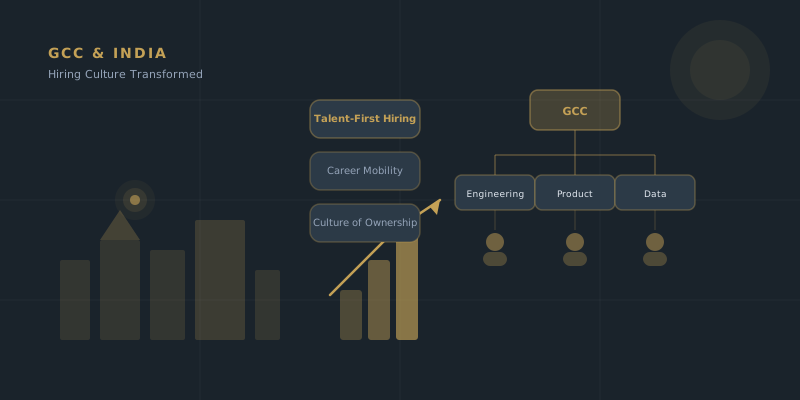
When the first wave of Global Capability Centres arrived in India in the late 1990s, the conversation was mostly about cost. Cheap labour. Time zone overlap. A vast English-speaking graduate pool.
Two decades later, that framing looks almost embarrassingly narrow.
GCCs did not just bring jobs to India. They rewired how Indian professionals think about careers, ownership, and ambition. They changed what talent expects from employers, what employers expect from talent, and what the employment relationship itself is supposed to feel like. Understanding that shift is essential for any organisation building an offshore engineering team today.
The Job Was Never Just a Job
Before GCCs scaled meaningfully in India, the dominant model for multinational engagement was traditional outsourcing. Indian engineers worked on contracts. They built what was specified. They delivered against a statement of work. Ownership of the product, the codebase, the architectural decisions, all of that lived with the client.
GCCs changed the offer entirely.
An engineer hired into a GCC was not a contractor. They were an employee of a global company, carrying that company's badge, using that company's tools, attending that company's all-hands. They were being asked, for the first time, not just to build but to care. To have opinions. To lead. To own.
That distinction sounds subtle. In practice, it was transformative. A generation of Indian engineers who might otherwise have spent careers executing project specifications instead spent them building product intuition, leading cross-functional teams, and operating with the kind of full-stack accountability that makes engineers genuinely senior rather than merely experienced.
"The GCC generation didn't just want a salary. They wanted to build something they could point to. That expectation has permanently changed what Indian professionals require from work."
What the Talent Market Looks Like Now
India's engineering talent market in 2026 is not the market that existed in 2005. The people entering the workforce today have grown up watching GCC leaders run global programmes from Bengaluru and Hyderabad. They have seen colleagues become CTO equivalents of regional organisations. They have watched the product of their engineering decisions land in the hands of global users.
Their expectations reflect that.
From stability to growth trajectory
Senior Indian engineers no longer accept roles that offer stability without a visible growth path. The GCC era made career progression into global leadership, into programme ownership, into architectural authority a baseline expectation rather than an aspiration. Organisations that offer a role without a trajectory will find it difficult to attract and retain the talent that actually moves work forward.
From execution to ownership
The most capable engineers in India today have held product-level ownership at some point in their careers. They have been responsible for outcomes, not just outputs. When you offer them a pure execution role and no product context, no architectural voice, no stake in what gets built then you are not offering them less seniority. You are offering them a step backward. The engagement model has to match what the talent has been trained to expect.
From team size to team quality
GCCs changed what engineers pay attention to when evaluating an opportunity. Headcount matters less than it used to. What matters now is who else is in the room. The quality of the engineering culture, the rigour of the code review process, the calibre of the architecture conversations, these are the signals that tell a good engineer whether an organisation is worth their time.
From location arbitrage to talent premium
Salary benchmarks in Indian tech have compressed significantly with global markets at the senior level. The idea that you can access world-class engineering talent in India for a fraction of comparable Western cost is still true, but the fraction is smaller than it was a decade ago, and it shrinks further every year. What you are really accessing is leverage: senior talent that is genuinely more affordable than its equivalent in San Francisco or London, but not cheap in any absolute sense.
The Hiring Consequence Nobody Talks About
The cultural shift GCCs produced has a hiring consequence that most organisations building new offshore teams underestimate: the talent you want is not waiting to be found.
The best engineers in India have options. They have always had options. But the GCC era created a generation of engineers with enough experience, confidence, and market value to be genuinely selective about where they take their next role. They evaluate opportunities not just on compensation but on the quality of the engineering problem, the credibility of the leadership, the cultural fit between the team in India and the team at headquarters, and the realistic probability that they will be operating with genuine autonomy rather than just executing instructions from abroad.
If your offshore model does not offer those things, you will not attract the engineers who have built anything worth building in the last ten years. You will attract the engineers who have not had other options.
What This Means for the Micro-GCC Model
The Micro-GCC model is a direct response to this reality. Not a response to the talent market as it existed in 2005, but to the talent market as it exists now.
A dedicated engineering pod in India is not built by posting job descriptions and seeing who applies. It is built by someone with an established reputation in the local engineering market, with credible relationships, with a track record that gives senior engineers a reason to take the conversation seriously. At Humalligence, that is the foundation our model is built on.
The engineers who join a Micro-GCC do so because the operating model offers what the GCC generation has learned to expect: ownership of a meaningful slice of work, visibility into the product roadmap, a relationship with the client team built on professional respect rather than instruction delivery, and a trajectory that does not cap out at senior engineer.
India's hiring culture was changed by GCCs. The organisations that understand what that change means, and build their offshore model accordingly, are the ones that will access the talent that actually moves things forward.
The ones that do not will keep wondering why their offshore team never quite delivers what they imagined it would.
Related Insights
The GCC Gap: Why Mid-Market Technology Companies Can No Longer Afford to Wait
Enterprise companies have GCCs. Mid-market companies haven't had a viable alternative until now.
Why Your Outsourcing Partner Feels Like a Vendor
If your offshore team feels like a separate company rather than an extension of yours, the problem is structural, not personal.
Build a Team That Attracts the Best
The engineers who build things worth building have options. If you want them on your team, the model has to match what they have learned to expect. Let's talk about what that looks like for your organisation.
[email protected]No proposals. No scope documents. Just a direct conversation.